

Quantum Volume reaches 5 digits for the first time
5 perspectives on what it means for quantum computing
Ä¢¹½ÊÓƵ’s H-Series team has hit the ground running in 2023, achieving a new performance milestone. The H1-1 trapped ion quantum computer has achieved a Quantum Volume (QV) of 32,768 (215), the highest in the industry to date.
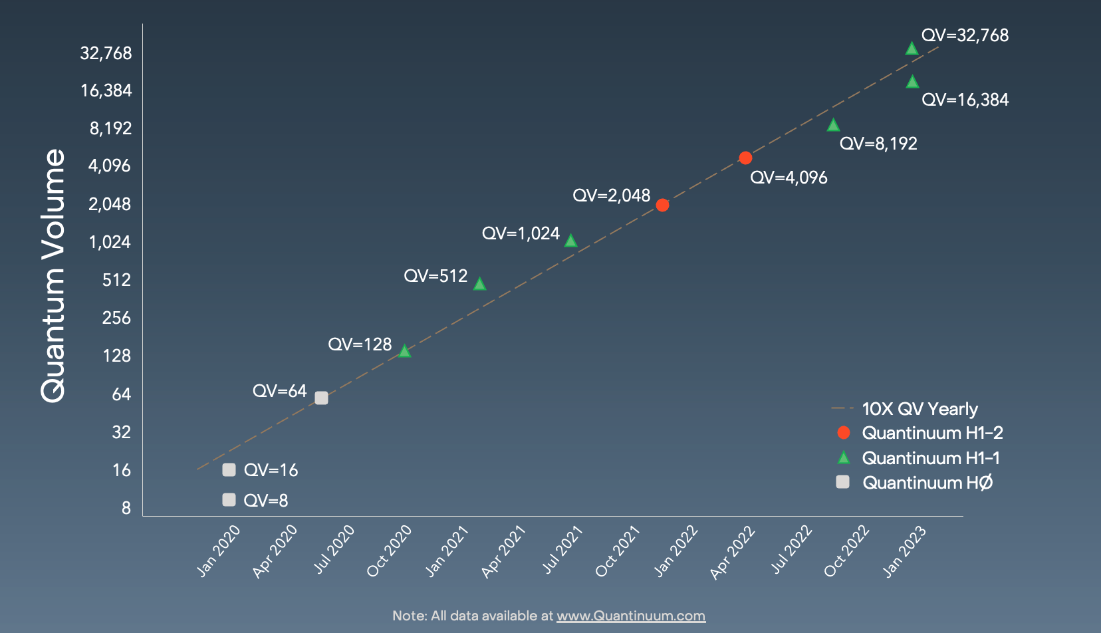
The team previously increased the QV to 8,192 (or 213) for the System Model H1 system in September, less than six months ago. The next goal was a QV of 16,384 (214). However, continuous improvements to the H1-1's controls and subsystems advanced the system enough to successfully reach 214 as expected, and then to go one major step further, and reach a QV of 215.
The Quantum Volume test is a full-system benchmark that produces a single-number measure of a quantum computer’s general capability. The benchmark takes into account qubit number, fidelity, connectivity, and other quantities important in building useful devices. While other measures such as gate fidelity and qubit count are significant and worth tracking, neither is as comprehensive as Quantum Volume which better represents the operational ability of a quantum computer.
Dr. Brian Neyenhuis, Director of Commercial Operations, credits reductions in the phase noise of the computer’s lasers as one key factor in the increase.
"We've had enough qubits for a while, but we've been continually pushing on reducing the error in our quantum operations, specifically the two-qubit gate error, to allow us to do these Quantum Volume measurements,â€� he said.Â
The Ä¢¹½ÊÓƵ team improved memory error and elements of the calibration process as well.Â
“It was a lot of little things that got us to the point where our two-qubit gate error and our memory error are both low enough that we can pass these Quantum Volume circuit tests,â€� he said.Â
The work of increasing Quantum Volume means improving all the subsystems and subcomponents of the machine individually and simultaneously, while ensuring all the systems continue to work well together. Such a complex task takes a high degree of orchestration across the Ä¢¹½ÊÓƵ team, with the benefits of the work passed on to H-Series users.Â
To illustrate what this 5-digit Quantum Volume milestone means for the H-Series, here are 5 perspectives that reflect Ä¢¹½ÊÓƵ teams and H-Series users.
Perspective #1:Â How a higher QV impacts algorithms
Dr. Henrik Dreyer is Managing Director and Scientific Lead at Ä¢¹½ÊÓƵ’s office in Munich, Germany. In the context of his work, an improvement in Quantum Volume is important as it relates to gate fidelity.Â
“As application developers, the signal-to-noise ratio is what we're interested in,� Henrik said. “If the signal is small, I might run the circuits 10 times and only get one good shot. To recover the signal, I have to do a lot more shots and throw most of them away. Every shot takes time."
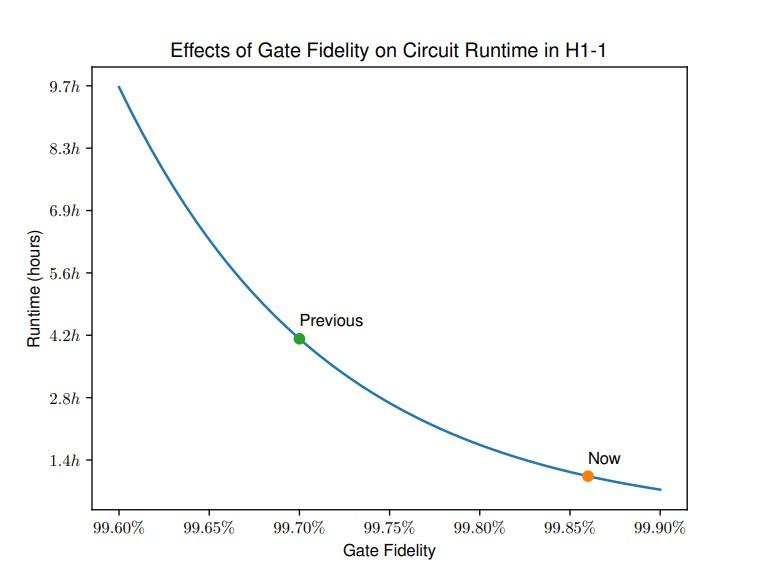
“The signal-to-noise ratio is sensitive to the gate fidelity. If you increase the gate fidelity by a little bit, the runtime of a given algorithm may go down drastically,� he said. “For a typical circuit, as the plot shows, even a relatively modest 0.16 percentage point improvement in fidelity, could mean that it runs in less than half the time.�
To demonstrate this point, the Ä¢¹½ÊÓƵ team has been benchmarking the System Model H1 performance on circuits relevant for near-term applications. The graph below shows repeated benchmarking of the runtime of these circuits before and after the recent improvement in gate fidelity. The result of this moderate change in fidelity is a 3x change in runtime. The runtimes calculated below are based on the number of shots required to obtain accurate results from the benchmarking circuit – the example uses 430 arbitrary-angle two-qubit gates and an accuracy of 3%.
Perspective #2:Â Advancing quantum error correction
Dr. Natalie Brown and Dr, Ciaran Ryan-Anderson both work on quantum error correction at Ä¢¹½ÊÓƵ. They see the QV advance as an overall boost to this work.Â
“Hitting a Quantum Volume number like this means that you have low error rates, a lot of qubits, and very long circuits,� Natalie said. “And all three of those are wonderful things for quantum error correction. A higher Quantum Volume most certainly means we will be able to run quantum error correction better. Error correction is a critical ingredient to large-scale quantum computing. The earlier we can start exploring error correction on today’s small-scale hardware, the faster we’ll be able to demonstrate it at large-scale.�
Ciaran said that H1-1's low error rates allow scientists to make error correction better and start to explore decoding options.
“If you can have really low error rates, you can apply a lot of quantum operations, known as gates,� Ciaran said. "This makes quantum error correction easier because we can suppress the noise even further and potentially use fewer resources to do it, compared to other devices.�
Perspective #3: Meeting a high benchmark
“This accomplishment shows that gate improvements are getting translated to full-system circuits,â€� said Dr. Charlie Baldwin, a research scientist at Ä¢¹½ÊÓƵ.Â
Charlie specializes in quantum computing performance benchmarks, conducting research with the Quantum Economic Development Consortium (QED-C).
“Other benchmarking tests use easier circuits or incorporate other options like post-processing data. This can make it more difficult to determine what part improved,â€� he said. “With Quantum Volume, it’s clear that the performance improvements are from the hardware, which are the hardest and most significant improvements to make.â€�Â
“Quantum Volume is a well-established test. You really can’t cheat it,� said Charlie.
Perspective #4:Â Implications for quantum applications
Dr. Ross Duncan, Head of Quantum Software, sees Quantum Volume measurements as a good way to show overall progress in the process of building a quantum computer.
“Quantum Volume has merit, compared to any other measure, because it gives a clear answer,â€� he said.Â
“This latest increase reveals the extent of combined improvements in the hardware in recent months and means researchers and developers can expect to run deeper circuits with greater success.â€�Â
Perspective #5:Â H-Series users
Ä¢¹½ÊÓƵ’s business model is unique in that the H-Series systems are continuously upgraded through their product lifecycle. For users, this means they continually and immediately get access to the latest breakthroughs in performance. The reported improvements were not done on an internal testbed, but rather implemented on the H1-1 system which is commercially available and used extensively by users around the world.
“As soon as the improvements were implemented, users were benefiting from them,� said Dr. Jenni Strabley, Sr. Director of Offering Management. “We take our Quantum Volume measurement intermixed with customers’ jobs, so we know that the improvements we’re seeing are also being seen by our customers.�
Jenni went on to say, “Continuously delivering increasingly better performance shows our commitment to our customers’ success with these early small-scale quantum computers as well as our commitment to accuracy and transparency. That’s how we accelerate quantum computing.�
Supporting data from Ä¢¹½ÊÓƵ’s 215 QV milestone
This latest QV milestone demonstrates how the Ä¢¹½ÊÓƵ team continues to boost the performance of the System Model H1, making improvements to the two-qubit gate fidelity while maintaining high single-qubit fidelity, high SPAM fidelity, and low cross-talk.
The average single-qubit gate fidelity for these milestones was 99.9955(8)%, the average two-qubit gate fidelity was 99.795(7)% with fully connected qubits, and state preparation and measurement fidelity was 99.69(4)%.
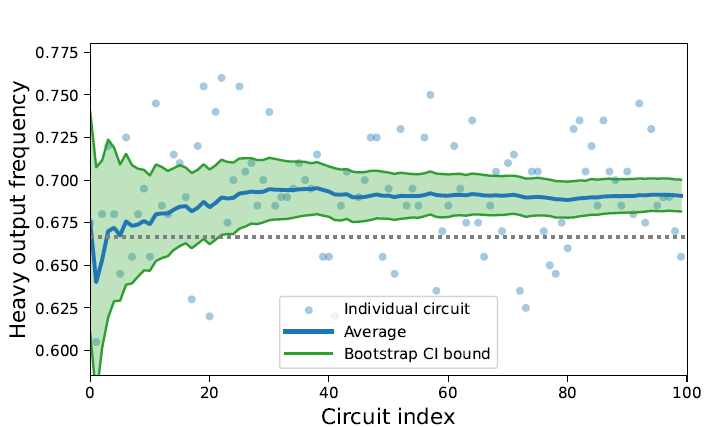
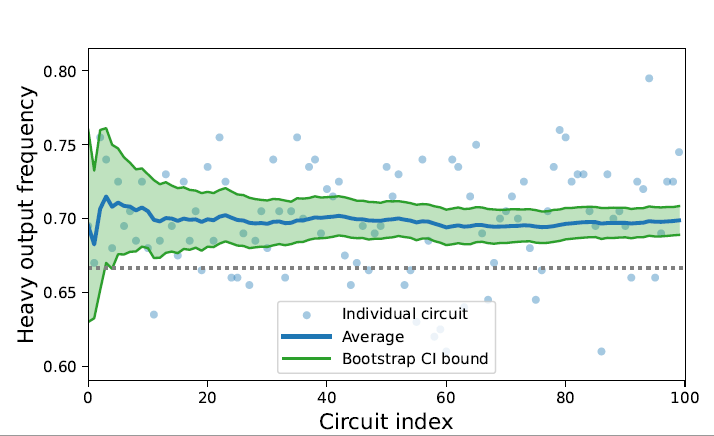
For both tests, the Ä¢¹½ÊÓƵ team ran 100 circuits with 200 shots each, using standard QV optimization techniques to yield an average of 219.02 arbitrary angle two-qubit gates per circuit on the 214 test, and 244.26 arbitrary angle two-qubit gates per circuit on the 215 test.
The Ä¢¹½ÊÓƵ H1-1 successfully passed the quantum volume 16,384 benchmark, outputting heavy outcomes 69.88% of the time, and passed the 32,768 benchmark, outputting heavy outcomes 69.075% of the time. The heavy output frequency is a simple measure of how well the measured outputs from the quantum computer match the results from an ideal simulation. Both results are above the two-thirds passing threshold with high confidence. More details on the Quantum Volume test can be found .
Heavy output frequency for H1-1 at 215 (QV 32,768)
Heavy output frequency for H1-1 at 214 (QV 16,384)Â
Quantum Volume data and analysis code can be accessed on . Contemporary benchmarking data can be accessed at .
1
About Ä¢¹½ÊÓƵ
Ä¢¹½ÊÓƵ, the world’s largest integrated quantum company, pioneers powerful quantum computers and advanced software solutions. Ä¢¹½ÊÓƵ’s technology drives breakthroughs in materials discovery, cybersecurity, and next-gen quantum AI. With over 500 employees, including 370+ scientists and engineers, Ä¢¹½ÊÓƵ leads the quantum computing revolution across continents.Â
Ä¢¹½ÊÓƵ and GE Vernova’s Advanced Research Center are launching a collaboration to apply quantum computing to one of the research community’s most consequential challenges: understanding the behavior behind high-temperature superconductivity. Advances in this field could, over the long term, transform the energy sector by enabling lighter generators, more compact and powerful motors, and electricity infrastructure that carries more power and better withstands faults.
The research will focus on Fermi–Hubbard modeling, a framework for studying how interacting electrons give rise to complex material properties. By combining Ä¢¹½ÊÓƵ’s full-stack quantum computing capabilities—including access to the company’s Helios computer—with GE Vernova’s expertise in material science and engineering simulation applied to industrial applications, the collaboration will bring an industry perspective to a promising area of quantum research.
Why superconductors matter for energy
As energy systems grow, the size, weight, and performance of electrical equipment become increasingly important constraints. High-temperature superconductors offer potential ways to address those limits through their ability to carry large electrical currents without resistance under suitable operating conditions.
Potential applications span power generation, electricity grids, and industrial electrification. Superconducting generators could reduce the weight and footprint of industrial equipment. Superconducting windings could also help make utility generators and industrial or marine propulsion motors more compact and efficient. In electricity networks, superconducting cables could carry more power through constrained spaces, while fault current limiters could help protect equipment during short circuits.
Realizing those benefits more widely depends on overcoming challenges in cooling, material performance, manufacturing, and cost. Better understanding of the physics behind high-temperature superconductivity could help inform the search for materials with more practical operating characteristics.
Why quantum computing may offer new tools for understanding high-temperature superconductivity
High-temperature superconductivity involves the collective behavior of strongly interacting electrons. Accurately modeling these systems is exceptionally difficult: the interactions that make them scientifically interesting also make important aspects of their behavior computationally challenging.
The Fermi–Hubbard model captures essential features of those interactions in a simplified mathematical framework. Although it is not a complete description of a material used in  industrial applications, it provides a foundation for investigating mechanisms associated with high-temperature superconductivity.
Quantum computing offers a promising way to explore the physics. Ä¢¹½ÊÓƵ researchers have already measured superconducting pairing correlations—including s-wave and d-wave pairing—in Fermi–Hubbard models simulated on the Helios quantum computer. These results demonstrate the ability to prepare and probe quantum states relevant to superconductivity research, establishing a foundation for further investigation.
The collaboration with GE Vernova will build on that foundation, bringing industrial expertise to the selection and interpretation of research questions.
Connecting quantum capabilities with industrial expertise
The research will be enabled through access to Ä¢¹½ÊÓƵ’s full-stack capabilities, including cloud-based access to Helios, the world’s most accurate quantum computer1, and Nexus, Ä¢¹½ÊÓƵ’s developer platform. Nexus connects quantum hardware with the software tools researchers need to develop and run applications in a unified environment.
GE Vernova’s Advanced Research Center brings the expertise in material science,  engineering, and industrial applications to the research and development activity. Â
“High-temperature superconductors could help us overcome important limits on the size, weight, and efficiency of electrical equipment, but understanding and improving these materials remains a significant scientific challenge,â€� said Jonathan Owens, PhD, Senior Scientist, Computational Materials Physics at GE Vernova. “By combining our materials simulation and industrial expertise with Ä¢¹½ÊÓƵ’s quantum computing capabilities, we can explore new approaches to these difficult problems while building the expertise to assess where quantum computing can make a meaningful contribution.â€�
The collaboration also extends GE Vernova’s exploration of quantum computing into a new area of materials research while supporting the development of its internal quantum talent. Its previous includes investigations of quantum algorithms for carbon-capture materials using simulated quantum processors.
Building toward industrial value
Translating insights from simplified models into practical materials requires sustained scientific and engineering work. Industrial expertise helps connect that effort to the properties, operating conditions, and manufacturing considerations that ultimately determine a material’s usefulness.
For Ä¢¹½ÊÓƵ, this collaboration is an opportunity to advance quantum simulation with an industrial collaborator that understands both the potential applications and the barriers to adoption. It brings together demonstrated computing capabilities, a challenging materials problem, and the expertise needed to connect scientific progress with industrial requirements.
The research collaboration aims to deepen understanding of this field and explore how quantum computing may contribute to future energy technologies.
1 Based on two-qubit gate fidelity as of December 31, 2025.
From Oracle's Quantum AI Compute beta program to upcoming Helios installation milestones and Oracle AI World, our partnership continues to gain momentum.
When Ä¢¹½ÊÓƵ and Oracle announced a strategic partnership earlier this year, the goal was not simply to deploy a quantum computer in the cloud. It was to create a practical path for bringing quantum computing into the enterprise environments where AI, data, and high-performance computing (HPC) already come together. Â
By combining Oracle Cloud Infrastructure (OCI)'s AI, data, and cloud capabilities with Helios, Ä¢¹½ÊÓƵ's most advanced quantum computer, we're helping lay the foundation for hybrid quantum AI computing at enterprise scale. The partnership reflects our belief that some of the most valuable future applications will emerge when quantum computing, AI and classical HPC work together to tackle problems that remain difficult to solve today. Â
Oracle Opens Early Access for Quantum AI Compute
That vision is now being put into practice. This month, Oracle launched the , giving select organizations an opportunity to begin evaluating how quantum computing fits into existing workflows and computational challenges.
Through the program, approved participants will gain cloud-based access to Helios, the world's most accurate commercial quantum computer, alongside OCI's GPU and HPC infrastructure. For organizations exploring quantum computing, this creates a practical starting point: access to industry-leading hardware within an enterprise cloud environment, without the need to build specialized infrastructure of their own.
The goal is to help organizations understand where hybrid quantum AI workflows may create value across areas such as drug discovery, materials science, energy, financial modeling, and optimization.
For many organizations, the starting point is not quantum technology itself. It's a business or research problem. Where are today's approaches reaching meaningful limits? Which workloads consume disproportionate resources? And where could a new computational capability create an advantage?
Organizations interested in participating can apply through Oracle's OCI Preview Programs . Oracle will review applications and select participants based on eligibility, capacity and program requirements.
Ä¢¹½ÊÓƵ and Oracle Leadership Takes the Stage at Oracle AI World
The opportunity for hybrid quantum-AI computing will be a major topic at . Â
In a main stage session, "," Larry Stack, Chief Commercial Officer at Ä¢¹½ÊÓƵ, will join Mahesh Thiagarajan, Executive Vice President and Head of Oracle Cloud Infrastructure, to discuss how quantum computing, AI and classical HPC can work together to address some of the world's most computationally demanding challenges.
The discussion will focus on a core question many organizations are asking: where should they start? Rather than leading with technology, the conversation will explore how organizations can identify high-value problems, establish today's performance baseline, and evaluate where quantum computing ultimately provides an advantage.
Later in the day, Ä¢¹½ÊÓƵ and Oracle experts will at how bringing Helios into OCI provides managed access to quantum computing natively within an enterprise cloud environment to support hybrid quantum-AI workflows.
Building Momentum Toward Hybrid Quantum-AI Computing
The collaboration between Ä¢¹½ÊÓƵ and Oracle continues to progress from vision to execution.
With Helios advancing toward installation, Oracle's Quantum AI Compute program now open for early access, and enterprise interest growing around hybrid computing, the pieces are coming together. Organizations now have a practical way to begin exploring quantum computing through cloud-based access to Helios alongside AI, HPC, and existing enterprise workflows.
We look forward to continuing the conversation at Oracle AI World 2026 and working with customers who want to better understand where hybrid quantum-AI computing can create real-world value.
We're excited to continue that conversation at Oracle AI World 2026 and to help customers begin exploring what's possible through the OCI Quantum AI Compute Beta Program.
By: David Hayes, Sr. Director of Computational Design and Integrated Software
Two recent announcements from Ä¢¹½ÊÓƵ and Google mark important progress toward fault-tolerant quantum computing.
Because both announcements focus on reducing errors, it may be tempting to compare the numbers directly. But these results are not the same. They measure different parts of the fault-tolerance challenge and answer fundamentally different technical questions.
This week, we a world-record error-correction result, using our error-correction architecture on Helios to deliver a logical fidelity of 99.9995%, equivalent to just five errors per million operations and representing a 100x reduction in errors compared to the best published result across any other modality—reported by . Â
Last week, Google a 99.99% magic-state fidelity result using a new cultivation technique, citing a 40x reduction in errors.
As fault-tolerant quantum computing matures, understanding what is being measured becomes just as important as understanding the headline number itself. Google's work measured the fidelity of a resource used in certain fault-tolerant operations. Our work measured the fidelity of the logical computation that consumes those resources.
Across the published results, Ä¢¹½ÊÓƵ demonstrates state-of-the-art performance in fault-tolerance, combining record logical computational fidelity with substantial advantages in resource efficiency. Understanding starts with examining what each study measured, what it achieved, and the resources it required.
Ä¢¹½ÊÓƵ's World-Record Result: Measuring the Accuracy of a Logical Computation
This week’s result measured how accurately an error-corrected logical quantum system can execute a computation.
To achieve the result, we used a well-known “color codeâ€� within our error-correction architecture. The error rate is 10 times lower than Ä¢¹½ÊÓƵ’s own world record achieved last month and 100 times lower than the best published result across all other hardware modalities—the 2024 Google result.
The study also demonstrated that logical errors fell exponentially as code distance increased. Code distance is a key measure of how quantum information can be protected as an error-correction system scales.
Each increase tested in the study reduced the remaining logical error rate by a record factor of 12, demonstrating exponentially effective error suppression as the code grows, a critical capability for scalable fault-tolerant quantum computing.
Together, these results demonstrate how Ä¢¹½ÊÓƵ's highly accurate trapped-ion hardware and flexible logical architecture can drive rapid gains in computational accuracy. They also show that fault-tolerant performance can be achieved with substantially fewer physical qubits than competing modalities.
The result places Ä¢¹½ÊÓƵ within the target logical-performance range required for Apollo, our planned universal fault-tolerant quantum computer targeted for 2029.
Google's Result: Advancing Magic-State Preparation
Google's latest paper focused on a different aspect of fault tolerance: the preparation of high-fidelity magic states.
Magic states are an important resource required for certain operations in a fault-tolerant quantum computer. Generating them efficiently is widely recognized as one of the key engineering challenges facing large-scale fault-tolerant systems, particularly for certain modalities.
Google's work introduced a new approach known as cultivation, designed to improve the fidelity of magic-state preparation while reducing the resources required to produce those states. The study demonstrated a magic-state fidelity of 99.99% using a protocol that retained approximately 8% of attempts while discarding the remainder. This post-selection process was a key contributor to the reported 40x reduction in error rate.
The study did not measure the fidelity of a larger logical computation that incorporates those magic states into an end-to-end algorithm. Instead, it focused specifically on the creation and refinement of the resource itself.
That distinction is important because preparing a high-fidelity resource and demonstrating the performance of a logical computation are different milestones on the path to fault tolerance.
Directly Comparing Ä¢¹½ÊÓƵ and Google’s Magic-State Results
Ä¢¹½ÊÓƵ's latest logical computation result should not be compared directly with Google's latest magic-state result. It should be compared against the distance scaling result published by Google in 2024.
That said, we have published studies measuring an analogous magic-state capability examined in Google’s latest work.
, we achieved 99.993% magic-state fidelity with an 85% retention rate, compared with the 99.99% fidelity and approximately 8% retention reported in Google’s latest work. Our result also required fewer physical qubits and fewer operational steps, resulting in significantly lower space-time overhead.
That combination of smaller qubit and operational steps footprint, along with substantially higher retention means fewer resources are consumed preparing each usable magic state.
As fault-tolerant systems scale, those efficiency advantages become increasingly important because they directly affect the amount of hardware required to perform useful computations.
The Bigger Picture
Taken together, these results establish Ä¢¹½ÊÓƵ’s leadership in demonstrated fault-tolerant performance: record logical computation fidelity, alongside a directly comparable magic-state result that achieves higher fidelity with substantially lower resource overhead.
That combination—computational accuracy and the efficiency with which it is achieved—is critical to delivering reliable answers to useful problems at a practical scale.
Ultimately, customers do not buy two-qubit gate fidelities or magic states. They buy answers.
Forward-Looking Statements
This blog post contains forward-looking statements within the meaning of the Private Securities Litigation Reform Act of 1995. These include statements about our technology roadmap, our expected logical performance, and the planned timing and capabilities of future systems, including Apollo. Words such as "target," "expect," "plan," and similar expressions identify forward-looking statements. These statements are based on our current expectations and involve risks and uncertainties that could cause actual results to differ materially. Those risks include challenges in developing, manufacturing, and scaling our quantum computing systems. For a discussion of these and other risks, see the "Risk Factors" section of our most recent Quarterly Report on Form 10-Q and our other filings with the SEC, available at ir.quantinuum.com. Forward-looking statements speak only as of the date of this post, and we undertake no obligation to update them except as required by law.