ĢƵ

Unlocking Quantum Advantage with Complement Sampling

Quantum computing continues to push the boundaries of what is computationally possible.

February 25, 2025

BY HARRY BUHRMAN

Quantum computing continues to push the boundaries of what is computationally possible. by Marcello Benedetti, Harry Buhrman, and Jordi Weggemans introduces Complement Sampling, a problem that highlights a dramatic separation between quantum and classical sample complexity. This work provides a robust demonstration of quantum advantage in a way that is not only provable but also feasible on near-term quantum devices.

The Complement Sampling Problem

Imagine a universe of N = 2n elements, from which a subset S of size K is drawn uniformly at random. The challenge is to sample from the complement ̅ without explicitly knowing S, but having access to samples of S. Classically, solving this problem requires roughly K samples, as the best a classical algorithm can do is guess at random after observing only some of the elements of S.

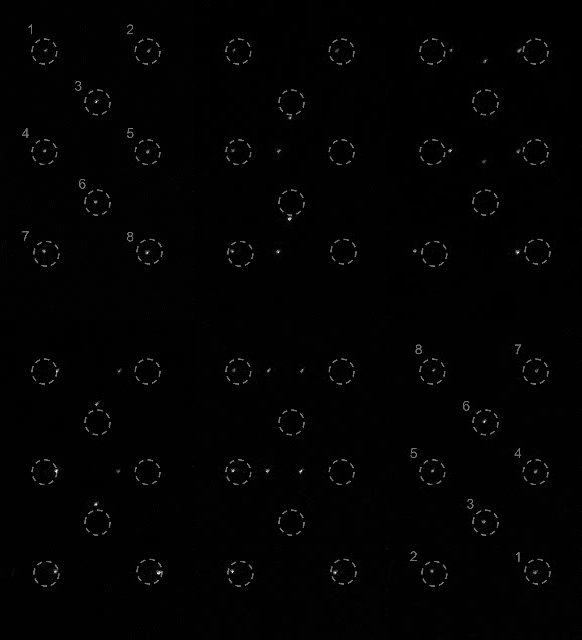
To better understand this, consider a small example. Suppose N = 8, meaning our universe consists of the numbers {0,1,2,3,4,5,6,7}. If a subset S of size K = 4 is drawn at random—say {1,3,5,7}—the goal is to sample from the complement  ̅, which consists of {0,2,4,6}. A classical algorithm would need to collect and verify enough samples from S before it could infer what ̅ might be. However, a quantum algorithm can use a single superposition state over S (a quantum sample) to instantly generate a sample from ̅, eliminating the need for iterative searching.

Why This Matters: Quantum Advantage in Sample Complexity

Quantum advantage is often discussed in terms of computational speedups, such as those achieved by Shor’s algorithm for factoring large numbers. However, quantum resources provide advantages beyond time efficiency—they also affect how data is accessed, stored, and processed.

Complement Sampling fits into the category of sample complexity problems, where the goal is to minimize the number of samples needed to solve a problem. The authors prove that their quantum approach not only outperforms classical methods but does so in a way that is:

  • Provable: It provides rigorous lower bounds on classical sample complexity, demonstrating an exponential separation.
  • Verifiable: The correctness of the output of the sampler can be efficiently checked classically.
  • NISQable: The quantum circuit required is shallow and feasible for Noisy Intermediate-Scale Quantum (NISQ) devices.
How the Quantum Algorithm Works

At its core, the quantum approach to Complement Sampling relies on the ability to perform a perfect swap between a subset S and its complement ̅. The method draws inspiration from a construction by Aaronson, Atia, and Susskind, which links state distinguishability to state swapping. The quantum algorithm:

  1. Uses a unitary transformation that maps the quantum sample |S⟩ to |̅⟩ with high probability.
  2. For K = N/2, the algorithm works perfectly outputting an element from ̅ with probability 1.
  3. For other values of K, a probabilistic zero-error approach is used, ensuring correctness while reducing success probability.

This is made possible by quantum interference and superposition, allowing a quantum computer to manipulate distributions in ways that classical systems fundamentally cannot.

Classical Hardness and Cryptographic Implications

A crucial aspect of this work is its robustness. The authors prove that even for subsets generated using strong pseudorandom permutations, the problem remains hard for classical algorithms. This means that classical computers cannot efficiently solve Complement Sampling even with structured input distributions—an important consideration for real-world applications.

This robustness suggests potential applications in cryptography, where generating samples from complements could be useful in privacy-preserving protocols and quantum-secure verification methods.

Towards an Experimental Demonstration

Unlike some quantum advantage demonstrations that are difficult to verify classically (such as the random circuit sampling experiment), Complement Sampling is designed to be verifiable. The authors propose an interactive quantum versus classical game:

  1. A referee provides a quantum player with quantum samples from S.
  2. The player must return a sample from ̅
  3. A classical player, given the same number of classical samples, attempts to do the same.

While the classical player must resort to random guessing, the quantum player can leverage the swap algorithm to succeed with near certainty. Running such an experiment on NISQ hardware could serve as a practical demonstration of quantum advantage in a sample complexity setting.

Future Directions

This research raises exciting new questions:

  • Can Complement Sampling be extended to more general probability distributions?
  • Are there cryptographic protocols that can directly leverage this advantage?
  • How well does the quantum algorithm perform in real-world noisy conditions?

With its blend of theoretical depth and experimental feasibility, Complement Sampling provides a compelling new frontier for demonstrating the power of quantum computing.

Conclusion

Complement Sampling represents one of the cleanest demonstrations of quantum advantage in a practical, verifiable, and NISQ-friendly setting. By leveraging quantum information processing in ways that classical computers fundamentally cannot, this work strengthens the case for near-term quantum technologies and their impact on computational complexity, cryptography, and beyond.

For those interested in the full details, the paper provides rigorous proofs, circuit designs, and further insights into the nature of quantum sample complexity. As quantum computing continues to evolve, Complement Sampling may serve as a cornerstone for future experimental demonstrations of quantum supremacy.

We have commenced work on the experiment – watch this space!

About ĢƵ

ĢƵ, the world’s largest integrated quantum company, pioneers powerful quantum computers and advanced software solutions. ĢƵ’s technology drives breakthroughs in materials discovery, cybersecurity, and next-gen quantum AI. With over 500 employees, including 370+ scientists and engineers, ĢƵ leads the quantum computing revolution across continents. 

Blog
|
corporate
March 25, 2026
Celebrating Our First Annual Q-Net Connect!

This month, ĢƵ welcomed its global user community to the first-ever Q-Net Connect, an annual forum designed to spark collaboration, share insights, and accelerate innovation across our full-stack quantum computing platforms. Over two days, users came together not only to learn from one another, but to build the relationships and momentum that we believe will help define the next chapter of quantum computing.

Q-Net Connect 2026 drew over 170 attendees from around the world to Denver, Colorado, including representatives from commercial enterprises and startups, academia and research institutions, and the public sector and non-profits - all users of ĢƵ systems.  

The program was packed with inspiring keynotes, technical tracks, and customer presentations. Attendees heard from leaders at ĢƵ, as well as our partners at NVIDIA, JPMorganChase and BlueQubit; professors from the University of New Mexico, the University of Nottingham and Harvard University; national labs, including NIST, Oak Ridge National Laboratory, Sandia National Laboratories and Los Alamos National Laboratory; and other distinguished guests from across the global quantum ecosystem.

Congratulations to Q-Net Connect 2026 Award Recipients! 

The mission of the ĢƵ Q-Net user community is to create a space for shared learning, collaboration and connection for those who adopt ĢƵ’s hardware, software and middleware platform. At this year’s Q-Net Connect, we awarded four organizations who made notable efforts to champion this effort. 

  • JPMorganChase received the ‘Guppy Adopter Award’ for their exemplary adoption of our quantum programming language, Guppy, in their research workflows. 
  • Phasecraft, a UK and US-based quantum algorithms startup, received the ‘Rising Star’ award for demonstrating exceptional early impact and advancing science using ĢƵ hardware, which they published in a December 2025 .
  • Qedma, a quantum software startup, received the ‘Startup Partner Engagement’ award for their sustained engagement with ĢƵ platforms dating back to our first commercially deployed quantum computer, H1.
  • Anna Dalmasso from the University of Nottingham received our ‘New Student Award’ for her impressive debut project on ĢƵ hardware and for delivering outstanding results as a new Q-Net student user. 

Congratulations, again, and thank you to everyone who contributed to the success of the first Q-Net Connect!

Become a Q-Net Member

Q-Net offers year‑round support through user access, developer tools, documentation, trainings, webinars, and events. Members enjoy many exclusive benefits, including being the first to hear about exclusive content, publications and promotional offers.

By joining the community, you will be invited to exclusive gatherings to hear about the latest breakthroughs and connect with industry experts driving quantum innovation. Members also get access to Q‑Net Connect recordings and stay connected for future community updates.

corporate
All
events
All
Blog
|
partnership
March 16, 2026
We’re Using AI to Discover New Quantum Algorithms

In a follow-up to our recent work with Hiverge using AI to discover algorithms for quantum chemistry, we’ve teamed up with Hiverge, Amazon Web Services (AWS) and NVIDIA to explore using AI to improve algorithms for combinatorial optimization.

With the rapid rise of Large Language Models (LLMs), people started asking “what if AI agents can serve as on-demand algorithm factories?” We have been working with Hiverge, an algorithm discovery company, AWS, and NVIDIA, to explore how LLMs can accelerate quantum computing research.

Hiverge – named for Hive, an AI that can develop algorithms – aims to make quantum algorithm design more accessible to researchers by translating high-level problem descriptions in mostly natural language into executable quantum circuits. The Hive takes the researcher’s initial sketch of an algorithm, as well as special constraints the researcher enumerates, and evolves it to a new algorithm that better meets the researcher’s needs. The output is expressed in terms of a familiar programming language, like Guppy or , making it particularly easy to implement.

The AI is called a “Hive” because it is a collective of LLM agents, all of whom are editing the same codebase. In this work, the Hive was made up of LLM powerhouses such as Gemini, ChatGPT, Claude, Llama, as well as which was accessed through AWS’ Amazon Bedrock service. Many models are included because researchers know that diversity is a strength – just like a team of human researchers working in a group, a variety of perspectives often leads to the strongest result.

Once the LLMs are assembled, the Hive calls on them to do the work writing the desired algorithm; no new training is required. The algorithms are then executed and their ‘fitness’ (how well they solve the problem) is measured. Unfit programs do not survive, while the fittest ones evolve to the next generation. This process repeats, much like the evolutionary process of nature itself.

After evolution, the fittest algorithm is selected by the researchers and tested on other instances of the problem. This is a crucial step as the researchers want to understand how well it can generalize.

In this most recent work, the joint team explored how AI can assist in the discovery of heuristic quantum optimization algorithms, a class of algorithms aimed at improving efficiency across critical workstreams. These span challenges like optimal power grid dispatch and storage placement, arranging fuel inside nuclear reactors, and molecular design and reaction pathway optimization in drug, material, and chemical discovery—where solutions could translate into maximizing operational efficiency, dramatic reduction in costs, and rapid acceleration in innovation.

In other AI approaches, such as reinforcement learning, models are trained to solve a problem, but the resulting "algorithm" is effectively ‘hidden’ within a neural network. Here, the algorithm is written in Guppy or CUDA-Q (or Python), making it human-interpretable and easier to deploy on new problem instances.

This work leveraged the NVIDIA CUDA-Q platform, running on powerful NVIDIA GPUs made accessible by AWS. It’s state-of-the art accelerated computing was crucial; the research explored highly complex problems, challenges that lie at the edge of classical computing capacity. Before running anything on ĢƵ’s quantum computer, the researchers first used NVIDIA accelerated computing to simulate the quantum algorithms and assess their fitness. Once a promising algorithm is discovered, it could then be deployed on quantum hardware, creating an exciting new approach for scaling quantum algorithm design.

More broadly, this work points to one of many ways in which classical compute, AI, and quantum computing are most powerful in symbiosis. AI can be used to improve quantum, as demonstrated here, just as quantum can be used to extend AI. Looking ahead, we envision AI evolving programs that express a combination of algorithmic primitives, much like human mathematicians, such as Peter Shor and Lov Grover, have done. After all, both humans and AI can learn from each other.

partnership
All
technical
All
Blog
|
partnership
March 16, 2026
Real Time Error Correction at Increased Scale

As quantum computing power grows, so does the difficulty of error correction. Meeting that demand requires tight integration with high-performance classical computing, which is why we’ve partnered with NVIDIA to push the boundaries of real-time decoding performance.

Realizing the full power of quantum computing requires more than just qubits, it requires error rates low enough to run meaningful algorithms at scale. Physical qubits are sensitive to noise, which limits their capacity to handle calculations beyond a certain scale. To move beyond these limits, physical qubits must be combined into logical qubits, with errors continuously detected and corrected in real time before they can propagate and corrupt the calculation. This approach, known as fault tolerance, is a foundational requirement for any quantum computer intended to solve problems of real-world significance.

Part of the challenge of fault tolerance is the computational complexity of correcting errors in real time. Doing so involves sending the error syndrome data to a classical co-processor, solving a complex mathematical problem on that processor, then sending the resulting correction back to the quantum processor - all fast enough that it doesn’t slow down the quantum computation. For this reason, Quantum Error Correction (QEC) is currently one of the most demanding use-cases for tight coupling between classical and quantum computing.

Given the difficulty of the task, we have partnered with NVIDIA, leaders in accelerated computing. With the help of NVIDIA’s ultra-fast GPUs (and the GPU-accelerated BP-OSD decoder developed by NVIDIA as part of library), we were able to demonstrate real-time decoding of Helios’ qubits, all in a system that can be connected directly to our quantum processors using .

While real-time decoding has been demonstrated before (notably, by our own scientists in this study), previous demonstrations were limited in their scalability and complexity.

In this demonstration, we used Brings’ code, a high-rate code that is possible with our all-to-all connectivity, to encode our physical qubits into noise-resilient logical qubits. Once we had them encoded, we ran gates as well as let them idle to see if we could catch and correct errors quickly and efficiently. We submitted the circuits via both as well as our own Guppy language, underlining our commitment to accessible, ecosystem-friendly quantum computing.

The results were excellent: we were able to perform low-latency decoding that returned results in the time we needed, even for the faster clock cycles that we expect in future generation machines.

A key part of the achievement here is that we performed something called “correlated” decoding. In correlated decoding, you offload work that would normally be performed on the QPU onto the classical decoder. This is because, in ‘standard’ decoding, as you improve your error correction capabilities, it takes more and more time on the QPU. Correlated decoding elides this cost, saving QPU time for the tasks that only the quantum computer can do.

Stay tuned for our forthcoming paper with all the details.

partnership
All